
Search Hawaii Police Records
Hawaii police records include arrest logs, criminal history files, and incident reports maintained by county police departments and state agencies across the islands. You can search conviction records online through the state's eCrim system, visit one of six public access sites in person, or write directly to the county department that filed the report. The Hawaii Criminal Justice Data Center serves as the statewide repository for criminal history data and issues official Police Clearance documents. This page explains where Hawaii police records are held, how to get them, and what laws govern access to them.
Hawaii Police Records Overview
What Hawaii Police Records Include
Hawaii police records is a broad term. It covers several types of documents, and what you can get depends on the record type and how a case turned out. Arrest records that ended in a conviction are public under HRS Chapter 846. The Hawaii Criminal Justice Data Center holds these for the entire state. Records from arrests that did not lead to a conviction are treated as confidential. Only criminal justice agencies and organizations authorized by state law can access non-conviction information. This is true even if you are asking about your own record through most standard channels.
Police reports are a separate category. These are the incident reports officers file when they respond to calls or investigate crimes. Each county department keeps its own reports. To get a copy, you contact the department that filed it. The state does not hold copies of local police reports. Fees and request procedures vary by county, so it pays to check with the right department first.
Criminal background checks, sometimes called a Police Clearance or Police Abstract, come from the HCJDC and search by either name or fingerprint. Fingerprint-based checks are more reliable because people sometimes use different names when arrested. Fingerprint comparison is the only way to be sure you have the right person's record. The HCJDC handles both types of checks.
The Hawaii Criminal Justice Data Center's records check page explains all available check types and what each one includes.
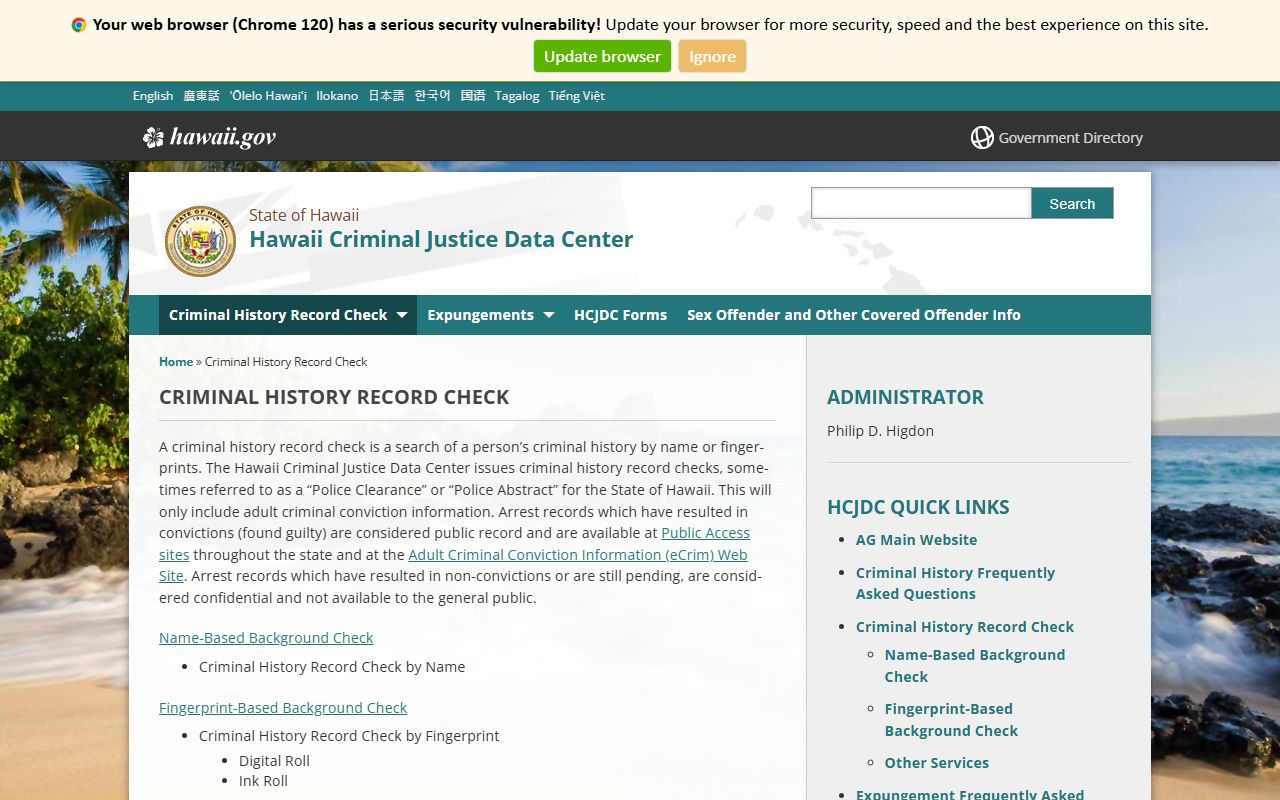
Both name-based and fingerprint-based options are listed there, along with the information required for each type.
Hawaii Criminal Justice Data Center
The Hawaii Criminal Justice Data Center is part of the Department of the Attorney General. The office is at 465 S. King Street, Room 102, Honolulu, HI 96813. The main phone line is (808) 587-3279. HCJDC issues criminal history checks for the state of Hawaii only. These records do not include arrests from other states or federal cases. For a national background check, you would need to contact the FBI directly through its Identity History Summary Checks program. HCJDC records are purely Hawaii-based.
Two background check types are offered. A name-based check uses the person's name, date of birth, social security number, and sex to search the system. The response notes that the check was name-based. A fingerprint-based check is the more reliable option. Under HRS Section 846-3, all Hawaii law enforcement agencies must report arrest data to HCJDC, making it the most complete source for Hawaii criminal history. Both digital roll and ink roll fingerprinting are available. The center also handles Access and Review requests so individuals can view their own records, and it processes expungements for eligible arrests under HRS Section 831-3.2.
Juvenile records are not part of standard HCJDC checks. For juvenile records, contact Hawaii State Judiciary Family Court at (808) 954-8190. The one exception is juvenile cases transferred to adult court, which may appear in the system.
The public access sites page at the HCJDC lists all six in-person locations statewide where criminal history printouts are available.
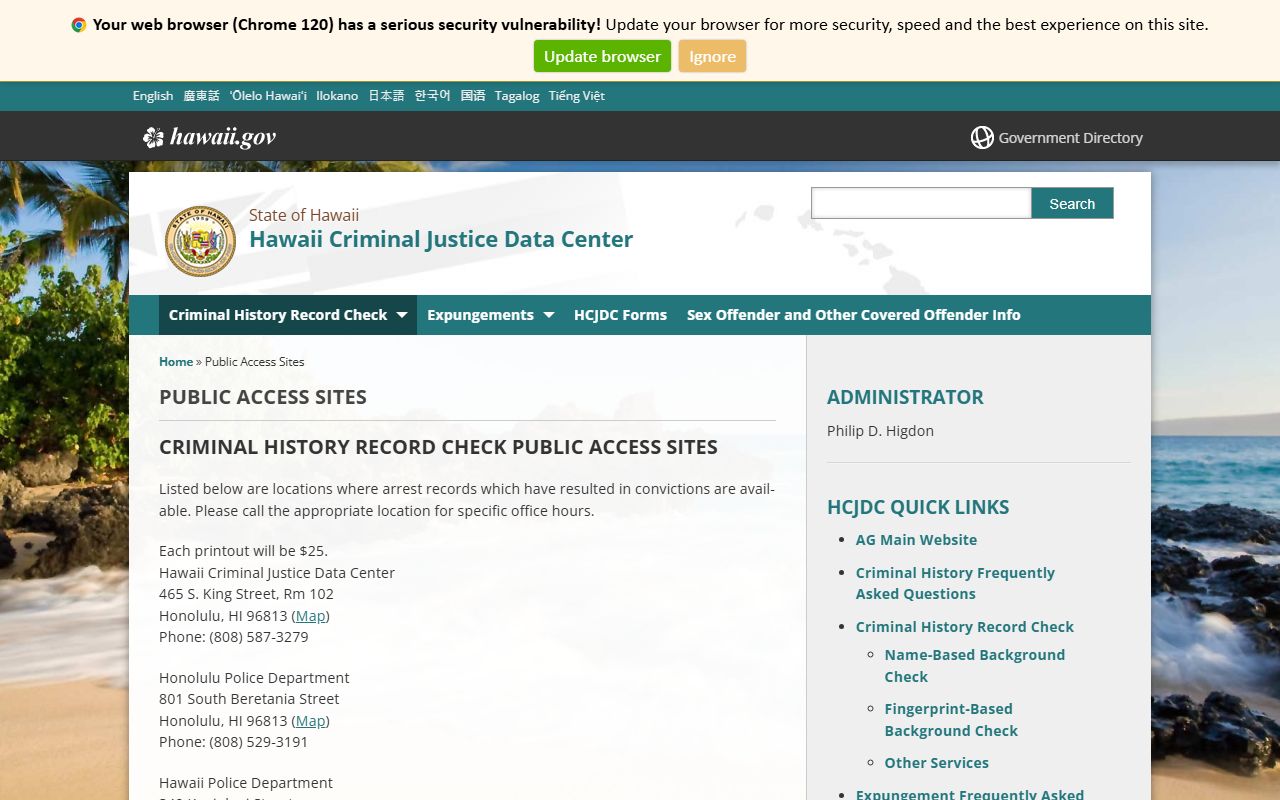
Each site charges $25 per printout, and the page includes addresses and phone numbers for all six locations.
Criminal History Record Fees in Hawaii
HCJDC has a fixed fee schedule. A public access printout at any of the six sites costs $25. A name check done by HCJDC staff runs $30. A fingerprint check costs $55 in person or $35 by mail. If you need the document certified, add $20. Notary services are free of charge. Sex offender record printouts have no fee at all. For expungements, the first one costs $35 and any after that run $50 each. No cash is accepted at the HCJDC office. Payments can be made by credit card, debit card, or Apple Pay, though all card transactions carry a 3% non-refundable service fee. Money orders and cashier's checks work at the office and by mail. Personal checks are not accepted for mail requests.
The eCrim online system has different pricing. Each unique name search costs $5. That gets you results on screen. A printed eCrim report costs $12, paid by credit card at checkout. You can run the same search more than once in a session at no extra charge. The session resets after logout or 30 minutes of no activity, so complete all steps before closing out. For data questions, call (808) 587-3279. For technical problems with the site, call (808) 695-4620.
The HCJDC FAQ page answers common questions about what criminal history checks include and who can access which types of records.
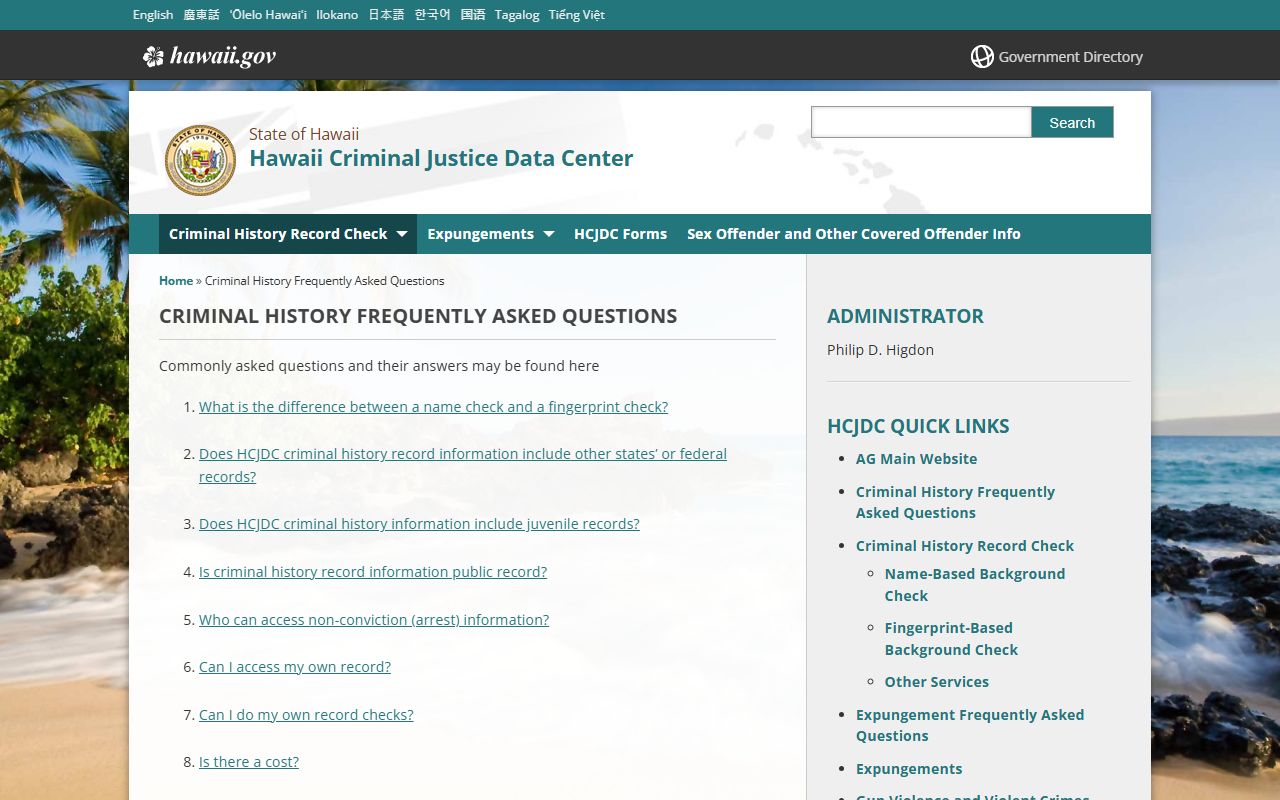
The FAQ covers alias names, the difference between conviction and non-conviction data, how fingerprints affect accuracy, and the process for challenging inaccurate records.
Note: HCJDC records cover Hawaii only. Arrests and convictions from other states or federal courts are not included in these checks.
Search Hawaii Police Records Online with eCrim
eCrim is the online system for searching adult criminal conviction records in Hawaii. It is operated by HCJDC and pulls from the same database used at public access sites. The process has four steps. First, enter search criteria such as name, social security number, date of birth, and gender. Second, pay for the search. Third, click View Search Results on the receipt screen. Fourth, add any records you want to your cart and check out.
A result of "No Criminal Convictions Found" is a valid outcome. It means no conviction is on file for that search. It does not mean no arrests ever happened. eCrim only shows conviction data. Pending cases and non-conviction arrests do not appear. The system runs around the clock, every day.
Under HRS Section 846-9, conviction information is public and may be shared without restriction. This is why eCrim is available to the general public without a special access account or prior approval.
Public Access Sites for Hawaii Police Records
Six locations across the islands let you get criminal history printouts in person. Each one charges $25 per search. Call ahead to confirm hours before you visit. Bring the subject's full name, date of birth, social security number, and sex for a name-based search. Cash is not accepted, so bring a money order, cashier's check, or a card.
The six public access sites are:
- Hawaii Criminal Justice Data Center: 465 S. King Street, Rm 102, Honolulu — (808) 587-3279
- Honolulu Police Department: 801 South Beretania Street, Honolulu — (808) 529-3191
- Hawaii Police Department (Hilo): 349 Kapiolani Street, Hilo — (808) 961-2233
- Kona Police Station: 74-5221 Queen Kaahumanu Highway, Kailua-Kona — (808) 326-4646 ext. 286
- Kauai County Police Department: 3990 Kaana Street, Lihue — (808) 241-1661
- Maui County Police Department: 55 Mahalani Street, Wailuku — (808) 244-6345
The Hawaii Department of Law Enforcement's UIPA request page explains how to submit a written records request for state law enforcement documents and what to include in your submission.
Requests must be in writing and include your contact information, a description of the record you want, and the format in which you would like to receive it.
How to Request a Hawaii Police Report
Police reports are distinct from criminal history records. Each county department handles its own requests. The process is similar statewide but the details differ by county.
In Hawaii County, the Records and Identification Section is at 349 Kapiolani Street, Hilo, HI 96720, phone (808) 961-2233. Hours are 7:45 a.m. to 3:30 p.m. You can request in person, by phone, or by mail. The fee is $1 for the first page and $0.10 for each page after that. Cash only is accepted there. Reports stay on hold until a case closes, though victims can sometimes get partial copies sooner for insurance purposes. If you are picking up a report on behalf of someone else, bring a signed letter of authorization. Hawaii County responds within 10 business days. The department also publishes booking logs covering individuals arrested and charged within a 48-hour period, which are available through the Hawaii Police Department website.
In Honolulu County, the Honolulu Police Department runs an online citizen report system for certain non-emergency incidents on Oahu. After you submit a request online, a police officer calls you back from (808) 768-0000. That number does not accept incoming calls, so answer when they reach out. Do not use the online system for emergencies, if a suspect is present or known, or if the incident happened outside Oahu.
Maui County Police Records Section is at 55 Mahalani Street, Wailuku, HI 96793, phone (808) 244-6400. Hours are Monday through Friday, 7:45 a.m. to 4:30 p.m., excluding holidays. In-person requests are accepted Monday through Thursday from 8 a.m. to 4 p.m. Fax requests go to (808) 244-6418. Mail and fax submissions must include a phone number, email address, and valid photo ID. Online requests can be submitted through the county public records portal. Processing takes up to 10 business days.
For Kauai County, call the Records Section at (808) 241-1655 or the main department line at (808) 241-1711. The Kauai County Police Records Section page also has information on submitting public police report requests online. All requests follow Hawaii's UIPA guidelines under HRS Chapter 92F.
Redacted copies are standard. Officers black out personal information for uninvolved parties, such as home addresses, email addresses, phone numbers, and date of birth. Your information as the requester stays in the report.
Note: Complete reports are not released until a case is closed or a statute of limitations has passed. Victims needing a report for insurance may be able to request a partial copy before that point.
Hawaii Court Records and eCourt Kokua
The Hawaii State Judiciary website gives public access to court case information through the eCourt Kokua system.

The system is free, available 24 hours a day, and covers civil, criminal, and traffic cases from all Hawaii counties. You can search by name or case number.
Results show charges filed, hearing dates, case status, and judgments. Some records may be restricted or sealed by court order. For help with the system, call (808) 539-4700. Public access terminals are also at courthouses statewide for those who prefer in-person searching. The Ho'ohiki system is a related tool on the judiciary's site that lets you search by party name, case number, or filing date range, and create an account to save searches and get notifications. Certified copies of court documents require a separate request through the clerk's office.
Circuit court locations for Hawaii police records cases: First Circuit Court serves Honolulu County at 777 Punchbowl Street, Honolulu, HI 96813, phone (808) 539-4700. Third Circuit Court handles Hawaii County at 777 Kilauea Avenue, Hilo, HI 96720, phone (808) 961-7400. Second Circuit Court covers Maui County and Kalawao County at 2145 Main Street, Wailuku, HI 96793, phone (808) 244-2929. Fifth Circuit Court handles Kauai County cases.
Inmate Lookup and Detention Records in Hawaii
The Hawaii Department of Public Safety website hosts the offender database for all state correctional facilities.
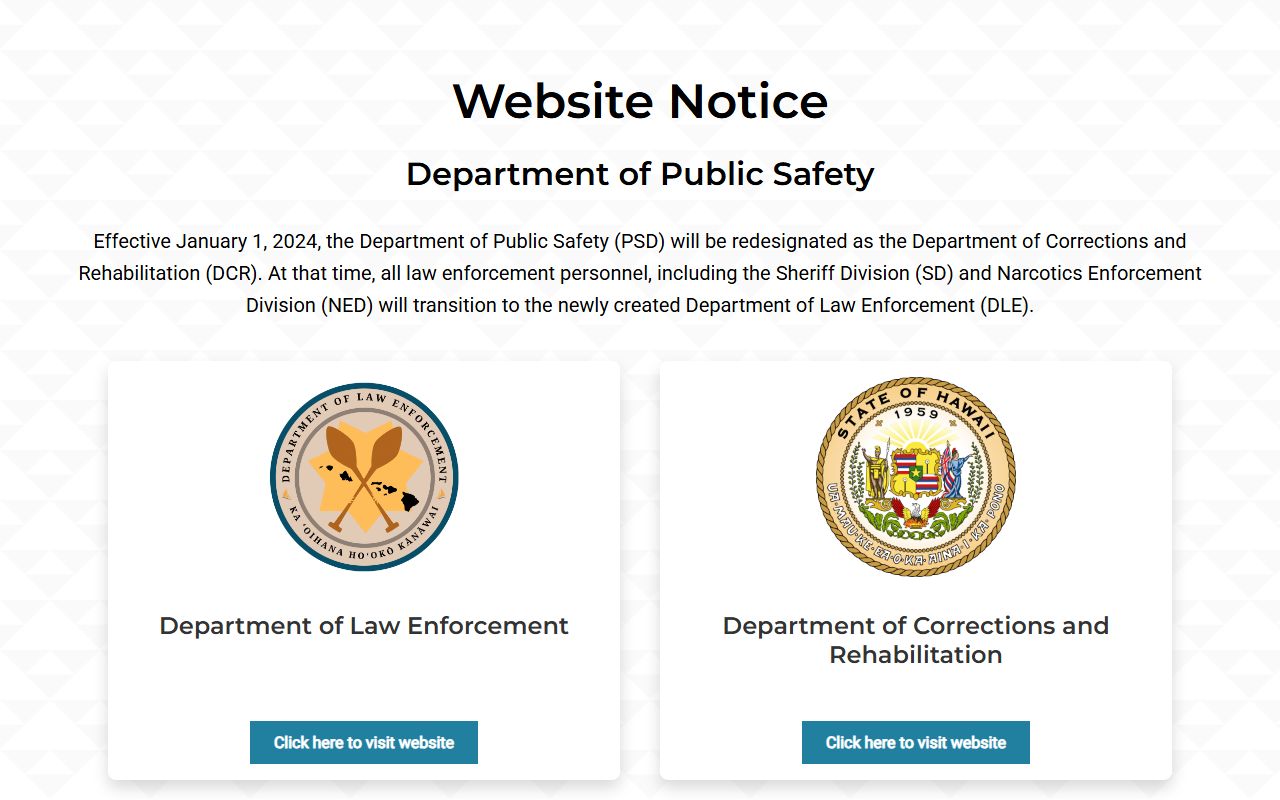
Search by name or identification number to find custody status, facility, and projected release information.
Hawaii runs four main correctional centers. Oahu Community Correctional Center is the primary pretrial facility on Oahu with a 950-bed capacity, holding Honolulu County arrestees who cannot post bail. Maui Community Correctional Center is at 600 Waiale Road, Wailuku, HI 96793, phone (808) 243-5900. Hawaii Community Correctional Center serves Hawaii County. Kauai Community Correctional Center serves Kauai County. For questions about a specific inmate, contact the relevant facility directly. The Department of Public Safety also oversees the Sheriff Division, which provides court security and prisoner transport statewide.
Hawaii does not have traditional county sheriffs. The Hawaii Sheriff Division, part of the Department of Law Enforcement at 715 South King Street, Room 505, Honolulu, Hawaii 96813, handles law enforcement in areas without local police, including Kalawao County. Sheriff deputies hold police powers statewide and coordinate with the National Park Service at Kalaupapa where needed.
Hawaii Public Records Laws
The full text of HRS Chapter 846, which governs criminal history records in Hawaii, is published on the state legislature's website.
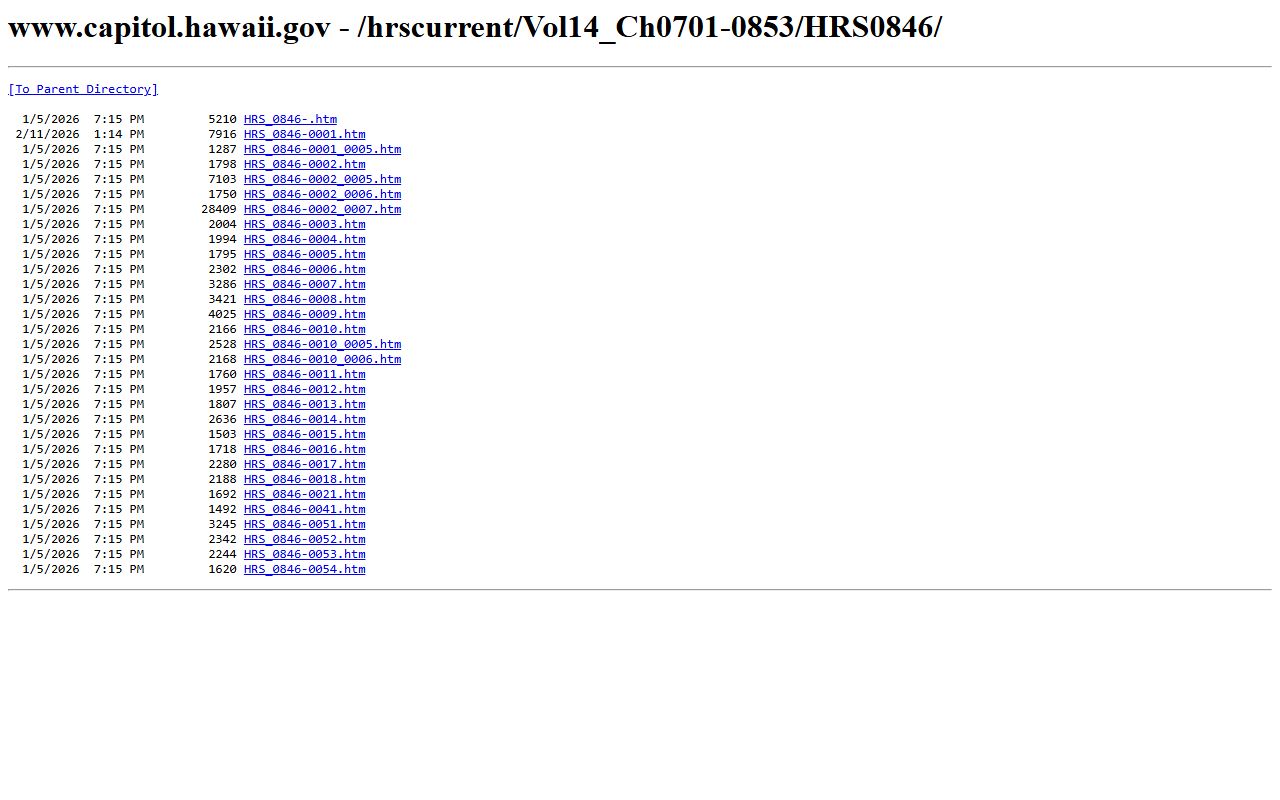
Chapter 846 establishes the HCJDC, sets rules for who can access what type of record, and spells out penalties for unauthorized disclosure of criminal history information.
Hawaii's main public records law is the Uniform Information Practices Act, or UIPA. It is codified at Chapter 92F, Hawaii Revised Statutes. Section 92F-12 requires agencies to disclose government records unless an exception applies. Section 92F-13 lists exemptions including records that could invade personal privacy or interfere with active investigations. Section 92F-14 identifies privacy interests that may justify limited access. Agencies must respond to written records requests within 10 business days. Section 92F-15 allows judicial enforcement if an agency fails to comply. Criminal penalties exist for unlawful disclosure or destruction of records under UIPA.
Under HRS Section 846-9, conviction information is public and may be shared without restriction. Non-conviction records are restricted and not available to the general public. Unauthorized sharing of criminal history data is a criminal offense. Individuals have the right to review their own records and challenge accuracy through HCJDC's Access and Review process.
The Office of Information Practices administers UIPA statewide and handles appeals when agencies deny public records requests.
OIP is at 250 South Hotel Street, Suite 107, Honolulu, HI 96813, phone (808) 586-1400. If an agency denies your records request, OIP investigates complaints and issues formal opinions on UIPA interpretation. The office also provides model request forms and training for both agencies and the public.
Browse Hawaii Police Records by County
Hawaii has five counties, each with its own police department and records process. Select a county below to find contact information, public access site details, and local resources for police records in that area.
Police Records in Major Hawaii Cities
Police records for major Hawaii cities are handled by the county department covering that area. Pick a city below to find the right department to contact and how to submit a records request locally.